Related Concepts
Angle of Attack
The vertical direction the clubhead is moving at the moment it contacts the ball — measured in degrees up or down. A negative number means the club is moving downward (hitting down on the ball); positive means upward. With irons, tour players average -4.3 degrees with a 7-iron, meaning the club is descending sharply into the ball. With driver, they're at -1.3 degrees — nearly level. The average amateur is only at -2.3 with a 7-iron (not enough downward) and actually hits UP on the driver (+2.5 to +3.0 degrees). This single number explains most of the distance and trajectory gap between good and average ball-strikers.
Why It Matters
Attack angle directly controls how much you compress the ball, how much spin you generate, and how your trajectory looks. A steeper (more negative) attack angle with irons creates more backspin, a lower launch, and a penetrating ball flight that holds its line in the wind. Too shallow means thin contact, less spin, and ballooning shots. Too steep means deep divots, inconsistency, and fat shots. Finding your optimal attack angle for each club is how you control trajectory and maximize distance.
See It In Action
Result
Strike
Why
Common Misconceptions
You should try to sweep the ball off the turf with irons.
TrackMan data is unambiguous: tour players hit down on every iron from -3.4 degrees (4-iron) to -5.0 degrees (PW). The ball gets in the way of a descending arc. "Sweeping" irons typically means the low point is behind the ball, producing thin and fat shots.
Hit down as hard as you can for more distance.
There's an optimal attack angle for each club. Tour players don't maximize steepness — they optimize it. Too steep (-7 or -8 degrees with a 7-iron) produces too much spin, launches too low, and costs distance. The goal is the tour range of -3.5 to -5.0 with mid-irons.
Attack angle and swing path are the same thing.
Attack angle is vertical (up/down). Swing path is horizontal (left/right of target). You can have a -4 degree attack angle with either an in-to-out or out-to-in path. They're independent measurements that happen simultaneously.
Expert Perspectives
Eric Cogorno (Eric Cogorno Golf)
"Attack angle should be trained directly with awareness drills and feedback tools. The player needs to feel the difference between -2 degrees and -5 degrees. TrackMan or a divot pattern gives that feedback."
Monte Scheinblum
"Don't think about attack angle. Think about rotation. If you rotate fully through the ball, the attack angle takes care of itself. Trying to control attack angle directly leads to arms-only manipulation."
Athletic Motion Golf (3D Analysis)
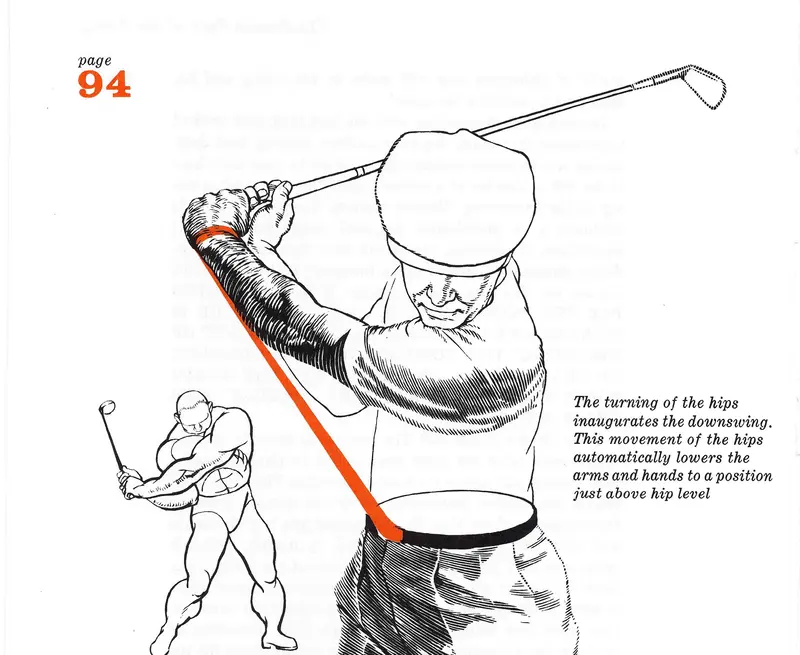
"The pivot controls attack angle. Specifically, the forward movement of the pelvis in transition shifts the low point forward, which steepens the effective attack angle on the ball. It's a body movement, not a hand movement."
George Gankas (GG SwingTips)
"Wrist conditions at impact control dynamic loft and effective attack. A player can have good rotation but still deliver the club too shallow if their wrists are flipping. Handle awareness matters."
Practice Drills
01 — Tee Height Progression
Start with the ball on a high tee. Hit 7-iron shots knocking the ball off the tee without hitting the tee out of the ground. Then lower the tee halfway. Then tee it barely above the ground. Then off the turf. Each step requires a slightly more descending blow. This trains your brain to find the ball with a downward arc without consciously "hitting down."
02 — Impact Bag Angle Check
Hit an impact bag and freeze at impact. Check: is the shaft leaning toward the target? Are your hands ahead of the clubhead? The shaft angle at impact is a direct reflection of your attack angle. If the shaft is vertical or leaning backward, your attack angle is too shallow.
Recommended gear
Affiliate link — we may earn a commission
03 — Board Drill (Half Swings)
Place a 2x4 flat on the ground about 3 inches behind the ball. Make half swings hitting the ball without touching the board. This forces a descending blow from in front of the board. If you hit the board, your attack angle is too shallow or your low point is too far back. Start with pitch shots.
Sources