Related Concepts
Weight Shift
How pressure moves between your feet during the swing. At address, pressure is roughly 50/50. In the backswing, it shifts toward the trail foot (right foot for right-handers). In the downswing, it shifts aggressively toward the lead foot — tour players have 80-95% of pressure on their lead foot at impact. You've felt this working when the swing feels "effortless" — that's the kinetic chain firing in sequence, with the ground as the starting point. You've felt it NOT working when you fall backward or feel stuck on your back foot — that's a reverse pivot.
Why It Matters
Weight shift is the engine that drives low point forward, creates descending contact, and generates power through the ground. Without proper pressure shift, the low point stays behind the ball (producing fat and thin shots), power gets generated with arms only (less speed, more injury risk), and the body stalls because it has no foundation to rotate against. Getting pressure to your lead side in transition is arguably the single most important move in the downswing for consistent iron play.
Common Misconceptions
Keep your weight centered throughout the swing.
Force plate data from TPI and Sportsbox shows tour players shift dramatically. By the time the club reaches the top, 60-80% of pressure is on the trail foot. By impact, 80-95% is on the lead foot. A "centered" swing that doesn't shift leaves the low point behind the ball.
Slide your hips toward the target in the downswing.
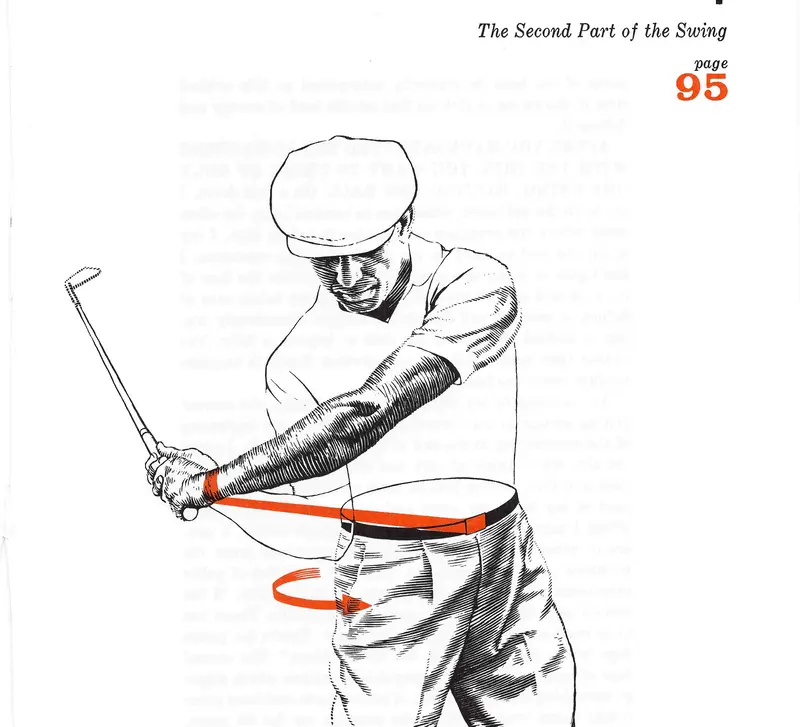
Weight shift is NOT a lateral slide. It's a pressure shift that happens through rotation. The hips turn, and the pressure moves as a consequence. Consciously sliding the hips leads to swaying, which keeps the upper body behind and promotes fat/thin contact.
Weight shift should be driven by the feet.
This is the Kelley/Hogan split in action. Hogan taught that the feet initiate the downswing. Kelley's system shows the hands pulling the body forward. Modern 3D data suggests the truth is somewhere in between — the lower body leads, but by a much smaller margin (20-40ms) than instructors used to claim.
Expert Perspectives
Athletic Motion Golf (3D Analysis)
"The pressure shift should be initiated by the lower body — specifically, the lead hip begins rotating open before the backswing is complete. The arms and club follow. This is the "ground up" sequence visible in 3D data."
George Gankas (GG SwingTips)
"The arms and hands pull the body forward. When you start the downswing with the hands, the body weight shifts as a reaction. Trying to shift with the lower body first often leads to spinning out and losing the hands behind the body."
Mike Malaska (Malaska Golf)
"The pressure shift is simple — it's an athletic move, like throwing a ball. You shift toward your target just like you would in any throwing sport. Stop thinking about it mechanically and just throw the club at the target."
Dr. Sasho MacKenzie
"The ground reaction forces data shows specific timing and magnitude that vary by skill level. Tour players apply a vertical force spike in transition of 150-170% body weight. This isn't just "athletic movement" — it's a trained, optimized pattern."
Practice Drills
01 — Step Drill
Start with your feet together, ball positioned normally. Make a backswing while stepping your lead foot forward (toward the target) to start the downswing. This forces you to shift your pressure forward before you swing down. Exaggerates the move. Start with half swings and 9-iron.
02 — Pressure Board (or Simply Stand on a Towel)
Place a folded towel under your lead foot only. Hit shots. If you're shifting pressure correctly, you'll feel heavy on the towel at impact. If you're hanging back, you'll feel light on it. The towel provides proprioceptive feedback without any swing thoughts.
03 — Trail Foot Lift at Finish
After every full swing, check: can you lift your trail foot completely off the ground and balance on your lead foot? If not, you didn't shift fully. Tour players finish with nearly all weight on the lead foot, trail toe barely touching. Practice holding this finish for 3 seconds.
Sources