Related Concepts
Swing Path
You feel like you're swinging the club toward the target, but TrackMan data reveals most golfers actually swing several degrees offline. Swing path (what TrackMan calls "club path") is the direction the clubhead is traveling at impact, measured in degrees relative to the target line. Positive numbers mean the club is moving to the right of target (in-to-out), negative means left (out-to-in). Tour average with a driver is about 1-2 degrees in-to-out. The average amateur swings 3-5 degrees out-to-in.
Why It Matters
Swing path is the other half of the ball flight equation. Clubface determines where the ball STARTS (roughly 85% of starting direction). Swing path, combined with the face angle, determines how much the ball CURVES. An in-to-out path with a face that's slightly closed to that path produces a draw. The same path with a face that's open to it produces a push-fade. Most amateurs fight an out-to-in path (over the top) which makes the face-to-path gap worse and amplifies their slice. Better players sometimes develop an excessively in-to-out path trying to draw the ball, which creates hooks when the face closes too much relative to the path.
See It In Action
Result
Strike
Why
Common Misconceptions
You should swing the club straight down the target line
The club actually swings on an arc. At impact it's crossing the target line, not traveling along it. A path that's 1-3 degrees in-to-out is considered "straight" in TrackMan terms. Trying to swing exactly down the line often produces an out-to-in path because of how the body rotates.
An in-to-out swing path always produces a draw
Path direction alone doesn't determine ball flight. An in-to-out path with a face that's open to the path still produces a fade or slice. The face-to-path relationship controls curve, not path alone.
You need to dramatically change your swing path to fix ball flight
Most ball flight issues are face problems, not path problems. TrackMan shows that changing the face angle by 2-3 degrees often has more impact on ball flight than changing path by the same amount, because the face controls 85% of starting direction.
Expert Perspectives
George Gankas (GG SwingTips)
"Path is secondary to face. Fix the face angle first and path often self-corrects because the compensation is no longer needed."
Athletic Motion Golf (3D Analysis)
"Path and face must be trained together. 3D data shows they're biomechanically linked through body rotation. You can't change one without affecting the other."
Monte Scheinblum
"Most path problems come from the body, not the arms. An over-the-top path is usually a rotation issue, not a hand path issue."
Eric Cogorno (Eric Cogorno Golf)
"Hand path and arm structure in the downswing directly control club path. Body rotation creates the environment, but the arms deliver the path."
Practice Drills
01 — Gate Drill for Path
Place two tees in the ground about 4 inches apart, just in front of the ball, aimed slightly right of target (for an in-to-out path). Practice swinging the clubhead between the tees without hitting them. This gives you instant feedback on your path direction. Start with pitch shots and work up.
02 — Inside Ball Drill
Place a second ball about 2 inches behind and 2 inches inside your target ball. Make swings hitting only the target ball. If you hit the inside ball, your path is too far from the inside (too in-to-out). If you miss both well inside, your path is out-to-in. The goal is to miss the inside ball by an inch.
03 — Alignment Stick Plane Drill
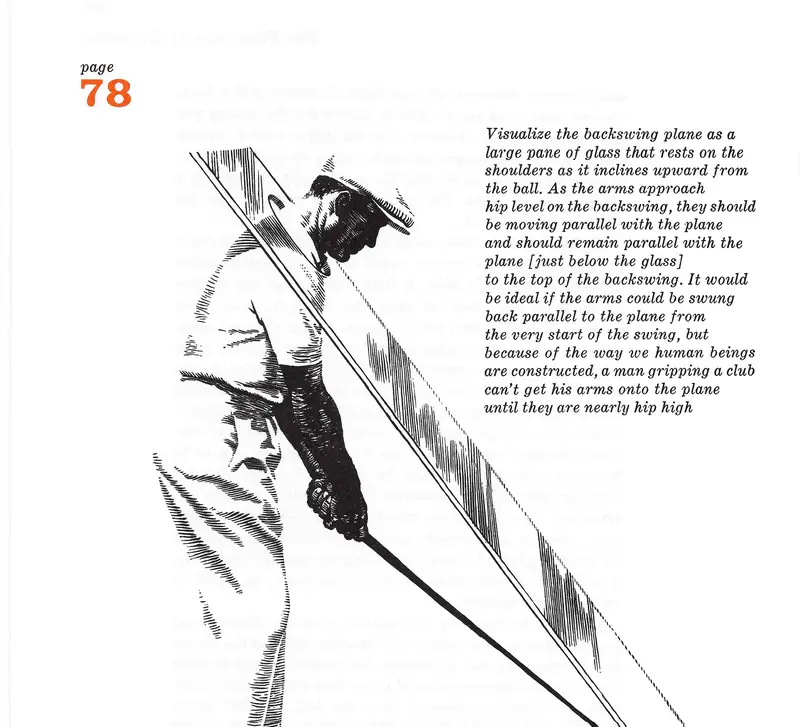
Stick an alignment rod in the ground at a 45-degree angle, positioned just outside your trail hip. Practice swinging under the stick in the downswing. This trains an on-plane path and prevents both over-the-top (out-to-in) and getting stuck (too in-to-out).
Recommended gear
Affiliate link — we may earn a commission
Sources