Related Concepts
Release
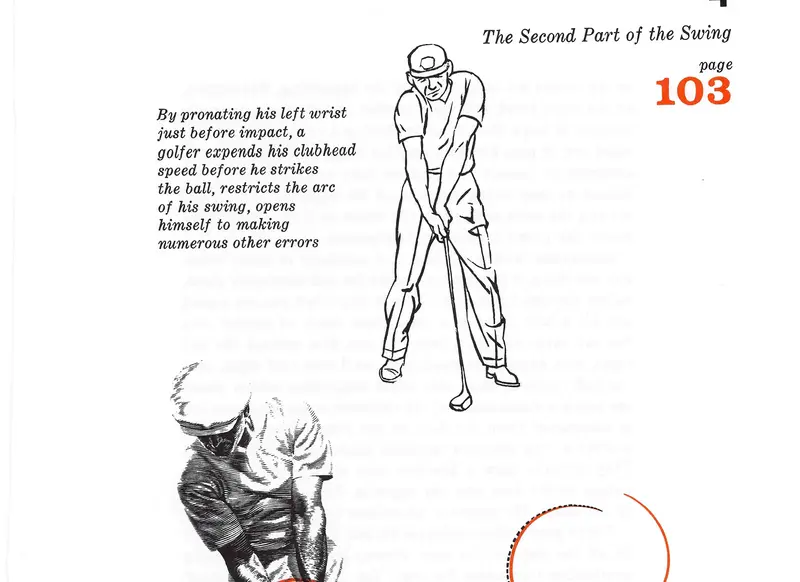
You feel your hands and forearms rotating through the ball, like you're turning a doorknob or pouring water out of a glass with your trail hand. What's actually happening is your forearms are supinating and pronating (rotating) as the club swings through the hitting zone, which controls how fast and how much the clubface rotates from open to closed through impact. A good release feels effortless, like the club is swinging itself. A bad release feels like you're fighting the club or flipping your wrists at the ball.
Why It Matters
The release is where clubhead speed is delivered and where the clubface squares up. Get it right and you compress the ball with a penetrating flight and consistent direction. Get it wrong in one direction (holding off the release) and you block it right with a weak fade. Get it wrong in the other direction (over-rotating or flipping) and you snap-hook it left. Tour players release the club through a consistent window, their forearm rotation matches their body rotation. High handicappers tend to have either no release (slice) or too much release (hook), usually because their body rotation stalls and their hands have to compensate.
Common Misconceptions
You should actively try to release the club by rolling your forearms through impact
For most golfers, the release happens naturally when your body rotation is correct. Actively rolling your forearms creates timing-dependent hooks. Better players focus on body rotation and let the hands follow, the release is a result, not an action.
A good release means your trail hand rolls completely over your lead hand
That's a flip, not a release. In a proper release, the forearms rotate but the wrist angles are maintained. The clubhead passes the hands AFTER impact, not AT impact. If your trail hand is rolling over before impact, you're flipping.
Holding off the release creates a more controlled shot
Holding off creates a weak, left-to-right shot and costs distance. Some tour players (Hogan era) held off intentionally, but modern equipment is designed to be released. Most amateurs who hold off are compensating for a strong grip, if they released with that grip, they'd hook it.
Expert Perspectives
Monte Scheinblum
"The release should be passive, driven by body rotation. Actively rotating forearms creates inconsistency and timing issues."
George Gankas (GG SwingTips)
"Players need to learn to actively manage forearm rotation to match their grip strength and swing path. A passive release only works with specific body patterns."
Athletic Motion Golf (3D Analysis)
"3D data shows tour players have significantly more forearm rotation through impact than amateurs. The release IS active, it's just well-timed."
Mike Malaska (Malaska Golf)
"The appearance of active rotation in 3D data is a result of proper sequencing, not a conscious effort. Teaching active rotation leads to over-rotation and hooks."
Practice Drills
01 — Split-Hand Release Drill
Grip the club with your hands 4-6 inches apart. Make slow half-swings focusing on how your trail hand rotates relative to your lead hand through impact. You should feel your trail palm going from facing the sky at hip-high in the downswing to facing the ground at hip-high in the follow-through. The separation makes the rotation obvious.
02 — Headcover Under Trail Arm
Tuck a headcover under your trail armpit. Make swings keeping it in place through impact. This forces your body to rotate through the shot rather than stalling, which naturally produces a proper release. If the headcover falls before impact, your arms are disconnecting and your hands are flipping.
03 — Pump Drill for Release Timing
Start your downswing but stop at hip height, three times in a row, feeling your weight shift and arms drop while your wrists stay hinged. On the fourth rep, swing through. This trains the sequencing that leads to a natural release: body first, arms second, hands last.
Sources